A very beautiful bird, more upright in stance than the India Blue. The overall coloration of metallic green feathers tipped with black, give the appearance of scales. The crest of this species stands nearly erect compared to the broad crest of its Indian relative; bare skin of blue and yellow beneath the eye, dark bluish-green metallic feathers on the remainder of the head and neck. The wing coverts are dark green and blue, with the flight feathers chestnut. The tail is similar to the India Blue, but is somewhat darker at the base and has a golden sheen throughout the train. There is slight variation between the subspecies: muticus is the brightest green of the three with bright iridescent blue and green wing coverts; spificer is much duller and there is more blue in the plumage than muticus and imperator; imperator is similar to muticus, but can be distinguished by having darker flanks, abdomen and secondaries and much lighter facial skin.
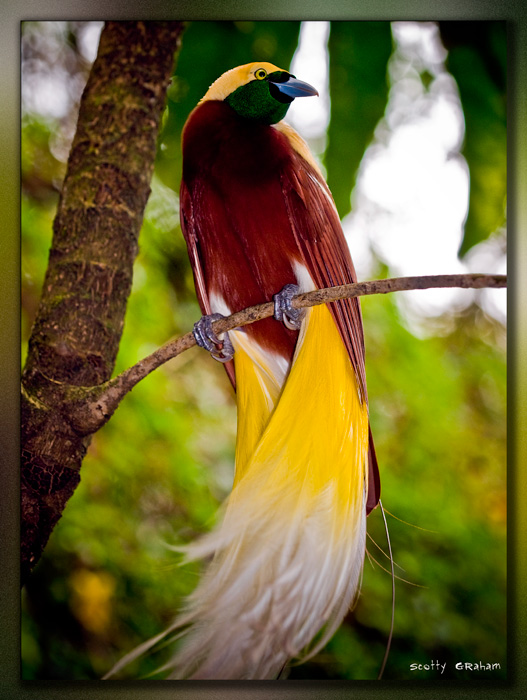
Birds of Paradise
The birds-of-paradise are members of the family Paradisaeidae of the order Passeriformes.
The majority of species in this family are found on the island of New Guinea and its satellites,
with a few species occurring in the Moluccas of Indonesia and eastern Australia. The family
has forty species in 13 genera. The members of this family are perhaps best known for the plumage
of the males of most species, in particular highly elongated and elaborate feathers extending
from the beak, wings or head. For the most part they are confined to dense rainforest habitat.
The diet of all species is dominated by fruit and to a lesser extent arthropods.
The birds-of-paradise have a variety of breeding systems, ranging from monogamy to lek based polygamy.
The family is of cultural importance to the inhabitants of New Guinea.
The trade in skins and feathers of the birds-of-paradise has been going on for two thousand years,
and the birds have been of considerable interest to western collectors, ornithologists and
writers as well. A number of species are threatened by hunting and habitat loss.
Description
Birds of paradise are generally crow-like in general body-form, and, indeed are the brother
group to the corvids (crows and jays). Birds-of-paradise range in size from the King Bird-of-paradise
at 50 g (1.8 oz) and 15 cm (5.9 in) to the Curl-crested Manucode at 44 cm (17 in) and 430 g (15 oz).
The male Black Sicklebill, with its long tail, is the longest species at 110 cm (43 in).
In all the males are larger and longer than the female, the differences ranging from slight to extreme.
The wings are rounded and in some species structurally modified on the males in order to make sound.
There is considerable variation in the family with regard to bill shape. Bills may be long and decurved,
as in the sicklebills and riflebirds, or small and slim like the Astrapias. As with body size
on average bill size varies with sex, although species where the females have larger bills than
the male are more common, particularly in the insect eating species.
Plumage variation between the sexes is closely related to breeding system. The manucodes and Paradise-crow,
which are socially monogamous, are sexually monomorphic. So are the two species of Paradigalla,
which are polygamous. All these species have generally black plumage with varying amounts of green and blue iridescence.
Habitat and distribution
The centre of bird-of-paradise diversity is the large island of New Guinea; all but two
genera are found in New Guinea. The two that are not are the monotypic genera Lycocorax and
Semiptera, both of which are endemic to the Moluccas, to the west of New Guinea. Of the
riflebirds in the genus Ptiloris, two are endemic to the coastal forests of eastern Australia,
one occurs in both Australia and New Guinea, and one is only found in New Guinea. The only
other genus to have a species outside New Guinea is Manucodia, one representative of which is
found in the extreme north of Queensland. The remaining species are restricted to New Guinea
and some of the surrounding islands. Many species have highly restricted ranges, particularly
a number of species with restricted habitat types such as mid-montane forest (like the Black Sicklebill)
or island endemics (like the Wilson's Bird-of-paradise).
The majority of birds-of-paradise live in tropical forests, including rainforest, swamps and moss forest.
Several species have been recorded in coastal mangroves. The southernmost species, the Paradise Riflebird
of Australia, lives in sub-tropical and temperate wet forests. As a group the manucodes are the most
plastic in their habitat requirements, with in particular the Glossy-mantled Manucode inhabiting both
forest and open savanna woodland. Mid-montane habitats are the most commonly occupied habitat,
with thirty of the forty species occurring in the 1000–2000 m altitudinal band.
Woolly-necked Stork ( Ciconia episcopus )
The Woolly-necked Stork, Ciconia episcopus, is a large wading bird in the stork family Ciconiidae.
It is a widespread tropical species which breeds in Africa, and also in Asia from India to Indonesia.
It is a resident breeder in wetlands with trees. The large stick nest is built in a forest tree,
and 2-5 eggs form the typical clutch. This stork is usually silent, but indulges in mutual
bill-clattering when adults meet at the nest.
The Woolly-necked Stork is a broad winged soaring bird, which relies on moving between thermals
of hot air for sustained long distance flight. Like all storks, it flies with its neck outstretched.
The Woolly-necked Stork is a large bird, typically 85cm tall. It is all black except for the woolly
white neck and white lower belly. The upperparts are glossed dark green, and the breast and belly
have a purple hue. Juvenile birds are duller versions of the adult.
African birds, C. e. microscelis, have the head mainly black, but the nominate Asian race, C. e. episcopus,
has the head mainly white except for a darker area around the eyes. Eastern Indonesian birds belong to a third form, C. e. neglecta.
The Woolly-necked Stork walks slowly and steadily on the ground seeking its prey,
which like that of most of its relatives, consists of amphibians, small reptiles and large insects.
African birds are attracted to bush fires.
The bird derives its scientific species name from the black and white vestments formerly worn by clerics.
The Woolly-necked Stork is one of the species to which the Agreement on the Conservation of African-Eurasian Migratory Waterbirds (AEWA) applies.
It is a widespread tropical species which breeds in Africa, and also in Asia from India to Indonesia.
It is a resident breeder in wetlands with trees. The large stick nest is built in a forest tree,
and 2-5 eggs form the typical clutch. This stork is usually silent, but indulges in mutual
bill-clattering when adults meet at the nest.
The Woolly-necked Stork is a broad winged soaring bird, which relies on moving between thermals
of hot air for sustained long distance flight. Like all storks, it flies with its neck outstretched.
The Woolly-necked Stork is a large bird, typically 85cm tall. It is all black except for the woolly
white neck and white lower belly. The upperparts are glossed dark green, and the breast and belly
have a purple hue. Juvenile birds are duller versions of the adult.
African birds, C. e. microscelis, have the head mainly black, but the nominate Asian race, C. e. episcopus,
has the head mainly white except for a darker area around the eyes. Eastern Indonesian birds belong to a third form, C. e. neglecta.
The Woolly-necked Stork walks slowly and steadily on the ground seeking its prey,
which like that of most of its relatives, consists of amphibians, small reptiles and large insects.
African birds are attracted to bush fires.
The bird derives its scientific species name from the black and white vestments formerly worn by clerics.
The Woolly-necked Stork is one of the species to which the Agreement on the Conservation of African-Eurasian Migratory Waterbirds (AEWA) applies.
Langganan:
Postingan (Atom)